Tag Archives: Word 365

Google Docs, Meet Word

When editors work in Word, they have access to many customizable tools and advanced features that make their work more consistent and faster:

Import–Export Handshake

The good news is that Google Docs plays well with Word, now. The bad news is that this requires you to (and only works if you do) export the document into a Word file, work on it, and then re-upload it to Google Docs when you are done.

I’ve let a couple of my editing students use it (for reasons) and am thrilled to find that Google Docs now produces great markup of the Tracked Changes and Comments when it makes a Word file. It also maintains my markup and comments from Word when I reupload it to Google Docs!

I still do better, faster editing work by using all my macros, plug-ins, and dozens of other customized tools in Word, so this compatibility is very hopeful news.

Markup Using Google Docs

The Suggesting feature in Google Docs marks up text much like Word does with Track Changes and Comments. The reason you want to use this is not only so that the changes stand out for review and can be easily accepted or rejected and so that comments are easy to find. More importantly, by leaving “suggestions” and tracked changes, you avoid having your comments and other infelicities end up in the final product because someone missed deleting them! This has happened many times and it is always an enormous embarrassment as it’s shared widely across the internet.

In Google Docs, click on the speech bubble icon at the top right of the screen. This opens the small menu shown in the image below. Click the Suggesting option to turn on the tracking mode. Then, type additions and delete text without further concern—they will be tracked. Add comments by clicking the speech bubble icon with the plus—the one just to the left of the pop-down menu in the example below.


Troubleshooting

Do not let the writer keep working on the Google Doc while you are editing in Word. These are now two separate versions of the file—the on in GDocs and yours in Word—and their changes will not be incorporated into your edits. You’ll be uploading a new version, separately, since you can’t upload–convert into an existing Google Doc. Ideally, you will lock the old Google Doc from further changes.

At minimum, add in a very large, colourful font at the top of the original Google Doc reading: DEAD FILE. Changing the colour and font family of the body content would also give visual signals that it is not the file to work on. Also change the doc’s name to include the words dead file.

While you might be frustrated by the seemingly endless updates (changes) to Microsoft products, Google Docs updates even more often. So what I say here may be out of date by the time you read it. So far, Google Docs keeps getting better and more functional. So let’s hope that’s what you find.

Styles and internal cross-references do not get carried over elegantly from Word to Google Docs. Just be aware of this, and plan on fixing the flubs in production/layout.

Erin Brenner of Right Touch Editing recently described her method of editing in Google Docs and limiting the pitfalls of working in a live document within GDocs, separate from Word. Check out her advice.

book cover cropped to banner size
For more details on using track changes and everything else mentioned in this post, check out the enhanced self-study workbook.


Got a gnarly Word problem? Submit your problem and we’ll try to answer it in the Q&A thread.


Learn with us! Join a course today.

© This blog and all materials in it are copyright Adrienne Montgomerie on the date of publication. All rights reserved. No portion may be stored or distributed without express written permission. Asking is easy!

Delivery image modified from original base image by mohamed Hassan on Pixabay.

This PDF Hack Accesses Your Word Wizardry

Missing all your Word tools because you’ve got a PDF to mark up? Never fear!

Open Word, then tell Word to open the PDF file. It’s that simple. Word will import all of the text and graphics so you can access your macros, plug-ins, and other secret Word weapons to proofread the content. No need to pay for any third-party translation or shell out for Acrobat Pro! Word has you covered.

Any changes will have to be transcribed onto the PDF, not simply tracked in the Word file; but that’s easy. This quick tutorial shows how to leave professional proofreading markup using the industry standard free software: Adobe Acrobat Reader.

Troubleshooting

Bad breaks or false ones may occur at the bottom of pages where footers including folios are set in text boxes. Some body text and captions may also appear in text boxes. Be sure Word is including such text in any checks, and be prepared to excuse layout weirdness. You’ll have to check design elements on the PDF itself.

If there’s any markup on the PDF, Word will try to replicate it, too. Just be aware of it so you can ignore those sections.


Got a gnarly Word problem? Submit your problem and we’ll try to answer it in the Q&A thread.


Learn with us! Join a course today.

© This blog and all materials in it are copyright Adrienne Montgomerie on the date of publication. All rights reserved. No portion may be stored or distributed without express written permission. Asking is easy!

Q&A: Easy selecting in tables, 5 ways

Skip to the demo video.

Q Is there a sure-fire way to select just the content of a table cell, or a single cell vs the whole table? Word seems to have its own views on what I should be selecting.

A Arrow keys are the most precise way to select text or cells (even rows and columns) in a table, but double-clicks and triple clicks are great shortcuts:

  • Shift + arrow selects individual characters until it reaches the end of a cell, then it switches to selecting whole cells.
  • Double-click the mouse to select a single word.
  • Triple-click the mouse to select a whole cell.

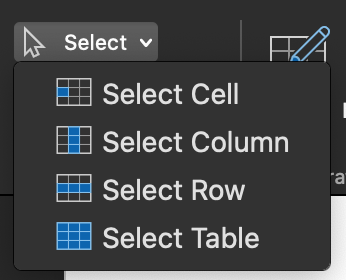
The (table) Layout ribbon offers some selection options. Click the Select icon on the far left. This is great when your hand isn’t feeling steady enough to activate the selection arrow by hovering at the top or left side of the table column/row, or when Word is having a tantrum. Just make sure the cursor is already placed in a cell within the column/table you want to select.

decorative
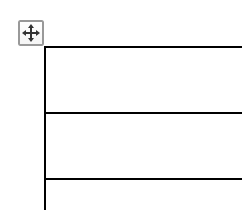
Use the grab point at the top left of a table to select the whole table. Click inside the table or hover the pointer over it to reveal the grab point.

Troubleshooting

To reveal the (table) Layout ribbon, place the cursor in the table. If the ribbon does not appear, you’re not working in a true table. Reveal hidden characters and you’ll likely find that the alignment was forced (faked) with spaces and tab marks. Undo that shit.

Note this (table) Layout ribbon is different from the Layout ribbon that is always visible (I’ve crossed out that other Layout tab at the left end). This special ribbon appears only when the cursor is inside a table.

If the content you want to select is at the end of a cell, it can be nearly impossible to select just that bit rather than the entire cell. Add a character (say, a period), then select up to that point (which will no longer be the end of the cell). Remember to delete that extraneous mark afterward!

To make sure you’ve selected an entire row (and not just the cells), look for the row end marker selection. See this in action in the demo video below at about minute 1:08.

Download a free workbook for editing tables. And check out the other blog posts on Working With Tables.


Got a gnarly Word problem? Submit your problem and we’ll try to answer it in the Q&A thread.


Learn with us! Join a course today.

© This blog and all materials in it are copyright Adrienne Montgomerie on the date of publication. All rights reserved. No portion may be stored or distributed without express written permission. Asking is easy!

Q&A: Can I accept only formatting changes?

Q Is there a way to only accept all formatting changes without accepting moved text? I can’t make it show *only* formatting. I can hide insertions/deletions and “accept all shown,” but that would also accept moves?

A You got it! Just hide all changes except the formatting ones and “Accept All Changes Shown” as shown in the steps below:

Continue reading Q&A: Can I accept only formatting changes?

Try This! Restructure Using Styles

In this exercise, you’ll practice applying Styles and using the Outline View.

Heading levels must be indicated in the manuscript in some way. Heads can’t simply be formatted as body text—even boldfacing will help the designer as much as the editor. And the reader absolutely needs them.

Continue reading Try This! Restructure Using Styles

Q&A: Keyboard Shortcut to Exit a Comment

Q Is there a way to get out of a Comment without using the mouse?

Esc, ←

A Yes, press Escape! Keeping your hands on the keyboard is the fastest way to work, and the perfect alternative to a mouse that’s lost its juice.

Troubleshooting

Continue reading Q&A: Keyboard Shortcut to Exit a Comment

Set Select Pages in Landscape

Wide tables and infographics are just two reasons you might want to set a particular page to print in the horizontal, landscape orientation. If you’re preparing a manuscript for professional design, doing this only helps you work with the material. And anything the helps your work is worth doing. But if you’re producing, for example, an internal report entirely within Word, adjusting the page orientation to fit the content is vital.

Landscape orientation.
portrait of Adrienne Montgomerie
Portrait orientation.

To prevent the entire file from being set in landscape, first insert Section Breaks. Find this function on the Layout ribbon (see figure). There are many uses for Section Breaks; here we’re just using them to confine the orientation to the desired pages. Select simply Break > Section Break, Next Page from the Page Breaks option in the Page Setup group.

Insert a Section Break both before and after the material that should be set in landscape. Then, place the cursor within that section, and select Orientation > Landscape on the Layout ribbon. That’s it!

The Section Breaks are visible here as a double-hashed line at the bottom of both the left and middle pages. With the cursor on the centre page, we can see that the Orientation on the Layout ribbon is set to Landscape.

Troubleshooting

Section break markers can get effectively hidden at the bottom of a very full page or even at the end of a line that nearly touches the margin. If you suspect a section break may be causing problems, search for them using regular expressions in the Find and Replace function.

book cover cropped to banner size
For instructions relating to section and page breaks, start on page 73 of the 2nd edition of the book.


Got a gnarly Word problem? Submit your problem and we’ll try to answer it in the Q&A thread.


Learn with us! Join a course today.

© This blog and all materials in it are copyright Adrienne Montgomerie on the date of publication. All rights reserved. No portion may be stored or distributed without express written permission. Asking is easy!

Horizontal Review Pane for Mac

Call it a glitch, but if you’re missing the horizontal Reviewing Pane option in MS Word on your Mac, you can turn this glitch into a happy hack!

Create a macro for adding a comment and assign a shortcut to it. That’s it. You don’t have to add anything else to the macro. Using the macro will automatically open each new comment in a Reviewing Pane along the bottom of the screen (see figure).

Continue reading Horizontal Review Pane for Mac

Find and Replace, Not Search and Destroy

Prevent Find and Replace from turning into “search and destroy” by using the Whole Word Only, option (“Find whole words only,” for Windows users). This feature helps you replace only whole words, and not matching fragments within other words.

Like a refined Find and Replace, the red-billed oxpecker picks parasites off an impala without hurting the host.

By simply selecting Whole Word Only, the software will identify only “man” and not “human“, for example. This helps to avoid replacement errors such as “inclient services” when attempting to replace instances of “patient.”

Continue reading Find and Replace, Not Search and Destroy